
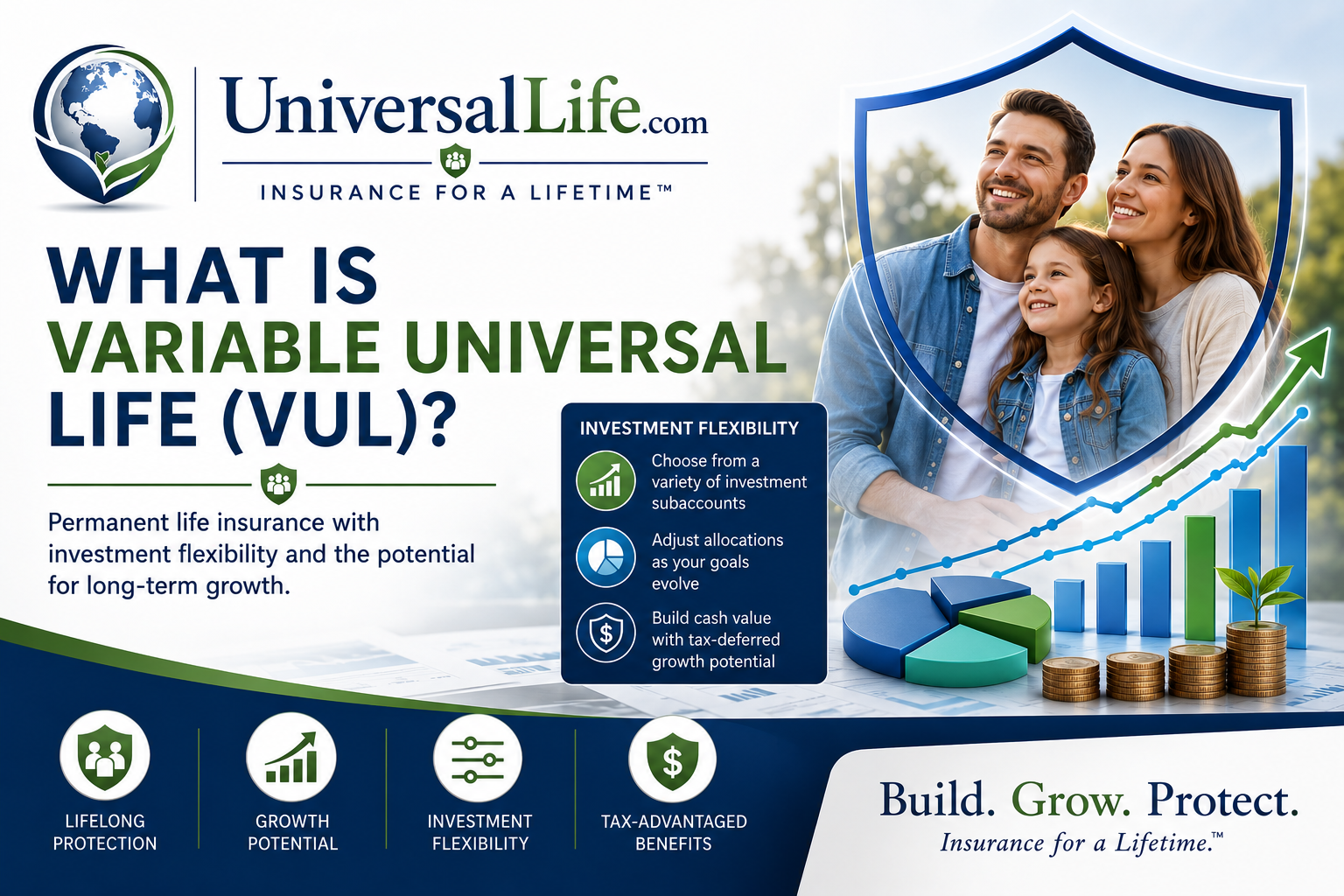
Variable Universal Life insurance, commonly known as VUL, is a type of permanent life insurance that combines lifelong coverage with investment opportunities. Unlike traditional life insurance policies that only provide a death benefit, VUL policies also allow policyholders to build cash value through professionally managed investment subaccounts tied to stocks, bonds, and other market-based investments.
Because of its flexibility and long-term growth potential, Variable Universal Life insurance is often used by individuals seeking permanent life insurance protection while also pursuing tax-advantaged wealth accumulation. However, unlike Indexed Universal Life (IUL) insurance, VUL policies involve direct market exposure, meaning policy values can rise or fall based on investment performance.
For investors, business owners, and high-income earners who are comfortable with market risk and want greater control over investment allocation, VUL can be a powerful financial planning tool.
This guide explains how Variable Universal Life insurance works, its features, advantages, risks, and how it compares to other types of life insurance.
Understanding Variable Universal Life Insurance
Variable Universal Life insurance is part of the broader category of universal life insurance, which is known for:
- Flexible premiums
- Adjustable death benefits
- Cash value accumulation
What makes VUL unique is that the policyholder can allocate cash value into investment-style subaccounts that resemble mutual funds.
These subaccounts may include investments such as:
- Large-cap stock funds
- Bond funds
- International equity funds
- Balanced portfolios
- Money market accounts
Unlike fixed or indexed universal life insurance, VUL cash value performance is directly tied to market performance.
This means:
- Strong markets can significantly increase policy value
- Poor markets can reduce cash value and potentially impact the policy
Because of this investment component, VUL policies are regulated as securities and must be sold by licensed professionals with securities registrations.
How Variable Universal Life Insurance Works
A Variable Universal Life policy contains two main components:
- Life Insurance Death Benefit
- Cash Value Investment Account
Each premium payment is divided into portions:
- One part covers the cost of insurance and policy expenses
- The remaining amount is directed into selected investment subaccounts
The policyholder chooses how the cash value is invested.
As investments perform:
- Cash value may grow
- The death benefit may increase depending on policy structure
- Policy loans and withdrawals may become available
However, if investments perform poorly:
- Cash value may decline
- Additional premiums may be required
- Policy lapse risk may increase
Key Features of Variable Universal Life Insurance
Permanent Life Insurance Coverage
VUL policies are designed to provide lifelong protection as long as sufficient cash value and premiums support the policy.
Unlike term life insurance, which expires after a fixed period, VUL remains in force indefinitely when properly funded.
This makes it useful for:
- Estate planning
- Wealth transfer
- Business succession
- Lifetime family protection
Investment Flexibility
One of the defining features of VUL is investment control.
Policyholders can typically allocate cash value among multiple investment options based on:
- Risk tolerance
- Investment objectives
- Market outlook
- Retirement goals
This flexibility allows for customized investment strategies within the policy.
Cash Value Accumulation
VUL cash value grows based on investment performance.
Unlike Indexed Universal Life insurance, which limits gains with caps and participation rates, VUL policies offer uncapped growth potential because investments are directly linked to market returns.
In strong market environments, this can lead to substantial long-term accumulation.
Flexible Premiums
Variable Universal Life insurance generally allows flexible premium payments.
Policyholders may:
- Increase contributions
- Reduce premiums
- Skip payments if sufficient cash value exists
This flexibility can help adapt the policy to changing financial situations.
Adjustable Death Benefits
Many VUL policies allow policyholders to:
- Increase death benefits
- Reduce coverage amounts
- Select different death benefit structures
This adaptability makes VUL useful for evolving financial and family needs.
How VUL Investments Work
The investment component of Variable Universal Life insurance is managed through subaccounts.
These subaccounts operate similarly to mutual funds and may invest in:
- Equities
- Fixed-income securities
- Index strategies
- Asset allocation portfolios
Policyholders choose how premiums are allocated among available investment options.
Example of a VUL Policy
Suppose a policyholder allocates cash value into:
- 70% stock subaccounts
- 30% bond subaccounts
If the market performs well:
- Cash value may experience significant growth
If markets decline:
- Cash value may decrease
- Policy sustainability may be affected
This direct market participation is the primary difference between VUL and IUL insurance.
Advantages of Variable Universal Life Insurance
Significant Growth Potential
Because VUL policies invest directly in market-based subaccounts, there is greater upside potential compared to many other permanent life insurance products.
Long-term investors may benefit from:
- Equity market appreciation
- Compound growth
- Tax-deferred accumulation
For aggressive investors, VUL can provide substantial wealth-building opportunities.
Tax Advantages
Variable Universal Life insurance offers several tax benefits.
Potential advantages include:
- Tax-deferred investment growth
- Income-tax-free death benefits
- Tax-free policy loans when properly managed
- Potential supplemental retirement income
These tax advantages make VUL attractive for retirement and estate planning strategies.
Investment Customization
Unlike traditional whole life policies with fixed returns, VUL allows policyholders to actively manage investments.
This flexibility appeals to investors who want:
- Market participation
- Portfolio diversification
- Control over allocation decisions
Some policies also offer professional portfolio management options.
Estate Planning Benefits
VUL policies are commonly used in advanced estate planning strategies because they can:
- Create tax-efficient wealth transfer
- Provide liquidity for estate taxes
- Support trusts and legacy structures
- Preserve family wealth across generations
Supplemental Retirement Income
Many policyholders use VUL as part of a retirement income strategy.
Over time, accumulated cash value may be accessed through:
- Policy loans
- Withdrawals
- Structured income distributions
When properly designed, this can create tax-advantaged retirement income.
Risks and Disadvantages of VUL Insurance
Although Variable Universal Life insurance offers powerful advantages, it also carries substantial risks.
Market Risk
The most important risk is investment volatility.
Unlike IUL policies that include downside protection floors, VUL policies are directly exposed to market losses.
Poor market performance can:
- Reduce cash value
- Increase lapse risk
- Require higher premiums
Policyholders must be comfortable with investment risk.
Complexity
VUL policies are sophisticated financial products.
Understanding:
- Investment allocations
- Insurance charges
- Loan mechanics
- Policy sustainability
- Tax implications
requires careful planning and ongoing management.
Higher Fees
Variable Universal Life insurance may include:
- Mortality charges
- Administrative fees
- Fund management expenses
- Surrender charges
- Rider fees
These costs can impact long-term returns.
Active Management Requirements
Unlike simpler insurance products, VUL often requires regular monitoring.
Policyholders may need to:
- Rebalance investments
- Adjust premiums
- Review performance
- Monitor policy health
Neglecting policy management can increase the risk of policy failure.
Potential Policy Lapse
If investment performance is poor and premiums are insufficient, the policy may lapse.
A policy lapse could result in:
- Loss of life insurance protection
- Tax consequences
- Loss of accumulated value
Proper funding is essential.
VUL vs. Other Types of Life Insurance
VUL vs. Whole Life Insurance
Whole Life Insurance
- Fixed premiums
- Guaranteed cash value growth
- Conservative returns
- Limited flexibility
Variable Universal Life Insurance
- Flexible premiums
- Market-based investment growth
- Greater upside potential
- Higher risk
Whole life prioritizes guarantees, while VUL prioritizes growth opportunity.
VUL vs. Indexed Universal Life (IUL)
Indexed Universal Life
- Index-linked interest crediting
- Downside protection floors
- Caps on gains
- Lower market risk
Variable Universal Life
- Direct market investment
- Unlimited growth potential
- Exposure to market losses
- Greater investment flexibility
IUL generally appeals to conservative growth-focused individuals, while VUL appeals to more aggressive investors.
VUL vs. Term Life Insurance
Term Life Insurance
- Temporary coverage
- Lower premiums
- No investment component
Variable Universal Life
- Permanent protection
- Investment-based cash value
- Higher premiums
- Long-term planning benefits
Term insurance is often used for short-term protection, while VUL is typically used for wealth-building and estate strategies.
Who Should Consider Variable Universal Life Insurance?
VUL insurance may be suitable for:
- High-income earners
- Experienced investors
- Business owners
- Estate planning clients
- Individuals seeking tax diversification
- Long-term retirement planners
Ideal candidates often:
- Have strong cash flow
- Understand investment risk
- Want permanent life insurance
- Have already maximized retirement accounts
- Seek tax-advantaged growth opportunities
Common Uses for Variable Universal Life Insurance
Wealth Accumulation
VUL can serve as a long-term asset accumulation vehicle for individuals seeking market exposure within a tax-advantaged structure.
Estate Planning
Large estates often use VUL to:
- Transfer wealth efficiently
- Reduce estate tax burdens
- Create inheritance liquidity
Executive Compensation
Businesses may use VUL policies for:
- Executive bonus plans
- Deferred compensation
- Key employee retention strategies
Supplemental Retirement Income
Many affluent individuals use VUL cash value to supplement retirement income while maintaining tax flexibility.
Important Questions to Ask Before Buying a VUL Policy
Before purchasing Variable Universal Life insurance, consider asking:
- What are the policy’s total fees?
- What investment options are available?
- What are the historical performance assumptions?
- How much market risk exists?
- How does the policy perform under stress scenarios?
- What happens if investments decline significantly?
- How are policy loans handled?
- What are the surrender charges?
Reviewing detailed policy illustrations is critical.
Choosing the Right Variable Universal Life Policy
Financial Strength of the Insurance Carrier
Choose insurers with strong financial ratings from organizations such as:
- AM Best
- Moody’s
- Standard & Poor’s
Strong carriers provide greater confidence in long-term stability.
Investment Options
Evaluate:
- Number of subaccounts
- Portfolio diversity
- Historical fund performance
- Management fees
Broader investment flexibility may improve customization opportunities.
Policy Charges
Understanding policy expenses is essential because high costs can reduce investment growth over time.
Review:
- Insurance costs
- Administrative fees
- Investment management expenses
- Loan interest rates
Final Thoughts
Variable Universal Life insurance is a sophisticated financial product that combines permanent life insurance protection with direct market investment opportunities.
For the right individual, VUL can provide:
- Lifelong coverage
- Tax-advantaged growth
- Investment flexibility
- Estate planning advantages
- Supplemental retirement income potential
However, VUL policies also involve substantial market risk, policy complexity, and ongoing management requirements. Because policy performance depends heavily on investment results and proper funding, careful planning is essential.
Individuals considering Variable Universal Life insurance should work closely with qualified insurance, financial, and tax professionals to determine whether a VUL strategy aligns with their long-term financial goals and risk tolerance.
Sources & References
- U.S. Securities and Exchange Commission – Variable Life Insurance Overview
- FINRA – Variable Universal Life Insurance
- Insurance Information Institute
- NAIC – Life Insurance Consumer Resources
- Investopedia – Variable Universal Life Insurance Explained
- Internal Revenue Service (IRS) – Life Insurance Guidance